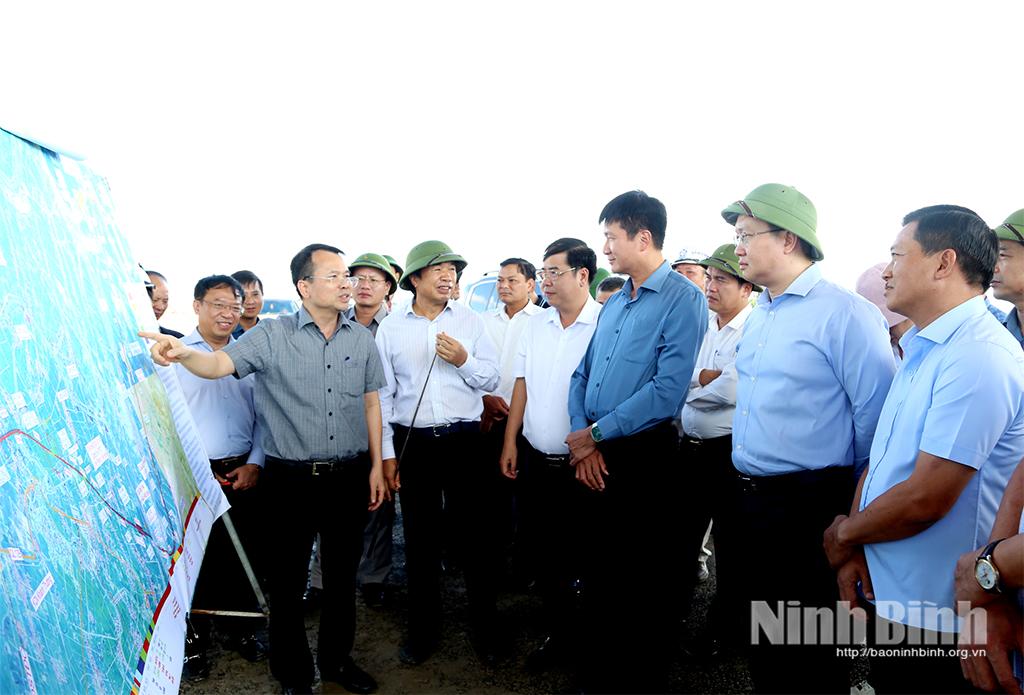

Secretary of Provincial Party Committee Tran Huy Tuan inspects progress of Ninh Binh - Hai Phong expressway project
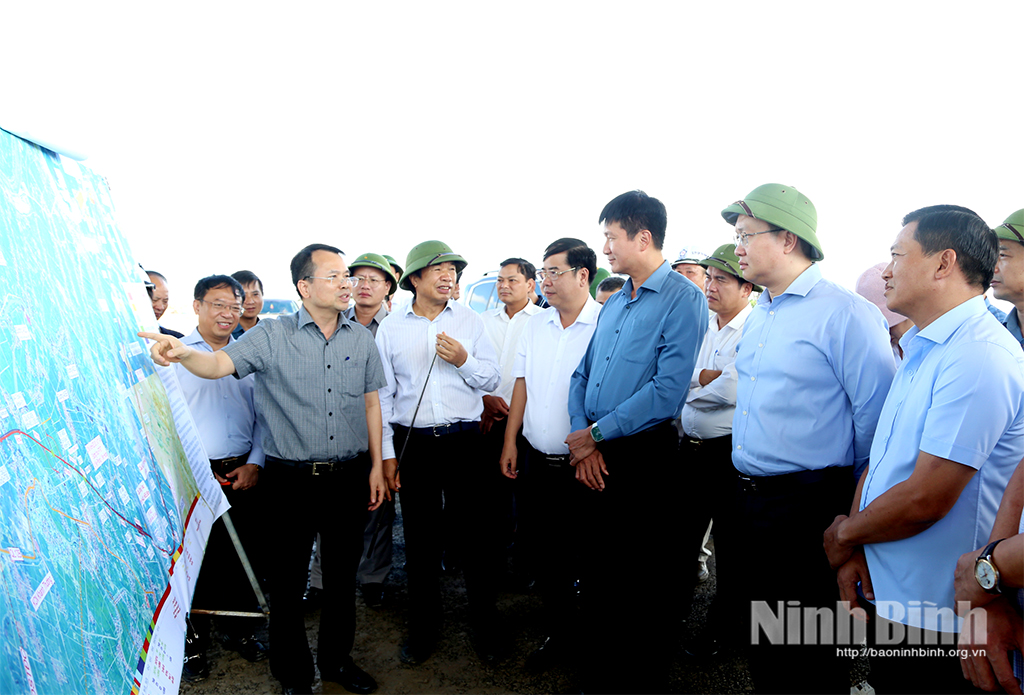
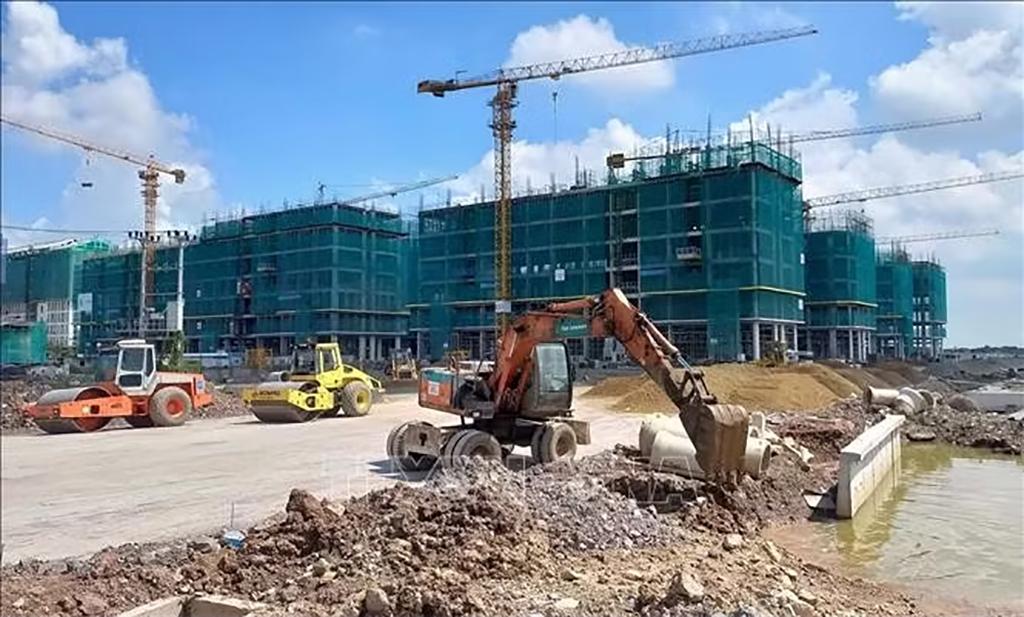
The delegation inspected construction sites along the Ninh Binh section of the expressway investment and construction project, including the Khanh Duong interchange (Km5+460), the Km7+000 section in Yen Mo commune, and the interchange connecting to the bridge over the Day River in Khanh Thien commune (Km25+100).
At the inspection sites, representatives of Construction Investment Project Management Board No. 1 and the contractors reported on the progress of construction packages, the completedworkload, outstanding difficulties and obstacles, and proposed measures to accelerate construction while ensuring project quality.
The Ninh Binh section of the Ninh Binh Hai Phong expressway is 25.3 kilometres long, with four lanes and a designed speed of 120 km/h. The project begins at the Mai Son interchange, which connects to the North South expressway in Yen Thang ward, and ends at the approach to the bridge over the Day River in Khanh Thiencommune.
The project has a total investment of over 9.11 trillion VND, with Construction Investment Project Management Board No. 1 serving as the investor. Additional project componentsare expected to be completed in 2028.
Regarding overall progress, site clearance for the main route has been completed in full, covering 217 hectares along the entire 25.3-kilometre section.
Additional service roads have also been largely completed, with only a number of graves in Yen Tu commune remaining to undergo relocation procedures.
After nearly 18 months of construction, which began on April 19, 2025, the project has recorded an implementation value of approximately 2.22 trillion VND out of the total contract value of 4.15 trillion VND, equivalent to 53.5%.
As for structures along the route, six of the 12 bridges, 48 of the 182 culverts and nine of the 19 underpasses have been largely completed. Construction of the remaining structures is ongoing.
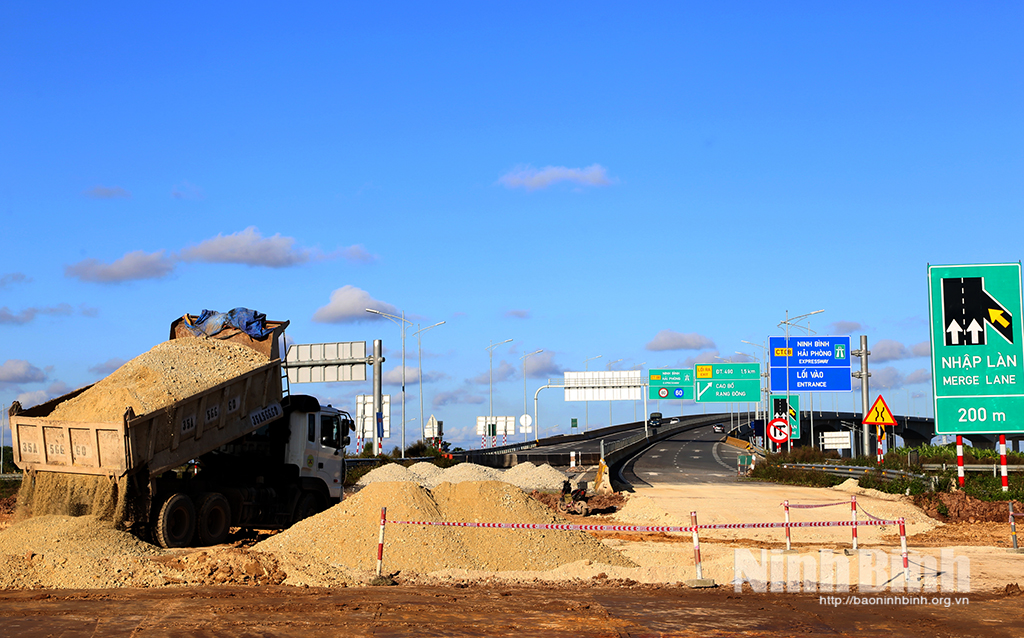
Cumulative disbursement since the project began has exceeded 4.9 trillion VND out of the allocated 6.72 trillionVND. In 2026 alone, disbursement reached 845.3 billion VND, equivalent to 31.6% of the annual capital allocation.
The project has encountered several difficulties affecting construction progress, including shortages of sand and soil for embankment works, delays in handing over certain sections of the site, and heavy rainfall between July and September 2026. These factors have affected the construction of road foundations, bridges, culverts and underpasses, as well as the transportation and stockpiling of construction materials.
In the coming period, the project will focus on accelerating construction, with the target of completing the dense-graded asphalt concrete surface course, grade 19, along the main route before December 31, 2026. All bridges, underpasses and culverts are also targeted for completion in December 2026.
Regarding capital disbursement, the project aims to fully disburse the remaining 1.82 trillion VND allocated for 2026.
After hearing the project report, Secretary of the Provincial Party Committee Tran Huy Tuan acknowledged and commended local authorities for their efforts in site clearance, which have helped ensure that the project proceeds as planned.
Tuan called on authorities at all levels, relevant departments and agencies, the investor and contractors to give top priority to accelerating construction. He stressed the need for regular on-site inspections, close monitoring of actual progress, and the timely identification and resolution of difficulties and obstacles. He also called for stronger coordination among agencies, units and local authorities to ensure that all project components are implemented in a synchronised and continuous manner.
He instructed the Department of Industry and Trade to urgently review available material mines, accelerate reserve assessments and complete licensing procedures for mining operations to ensure an adequate supply of construction materials for the project.
Construction contractors were asked to review and finalise all design and technical requirements to ensure that implementation remains on schedule.
The investor was also instructed to strengthen inspections and supervision, urge contractors to mobilise sufficient manpower and machinery, take advantage of favourable weather conditions and accelerate construction across all project components, with the aim of fully disbursing the allocated capital for the year.
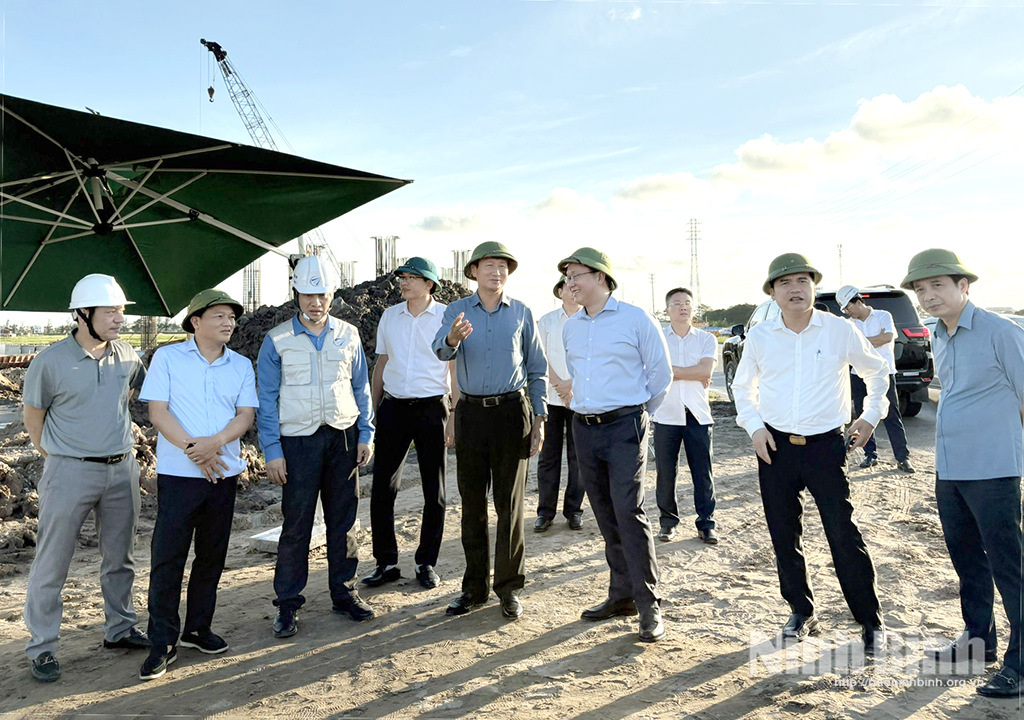
Following the inspection, Tuan and the delegation visited the site clearance area at Km41+500, in Xuan Giang commune, along the Ninh Binh Hai Phong expressway investment and construction project under the public-private partnership (PPP) model, covering the former Nam Dinh and Thai Binh provincial areas.
At the site, provincial leaders received a briefing on project implementation, focusing on site clearance in Xuan Giang commune, construction progress, difficulties encountered in coordination with local authorities, and proposed solutions to address outstanding issues.
The Ninh Binh Hai Phong expressway section running through former Nam Dinh and Thai Binh provinces is 60.9 kilometres long. Of this, 27.6 kilometres pass through former Nam Dinh province and 33.3 kilometres through former Thai Binh province.
The expressway is designed with four lanes and a maximum design speed of 120 km/h, with a total investment of 19.78 trillion VND. The project investor is a consortium led by GELEXIMCO. The project is expected to be substantially completed in 2027 and put into operation in 2028.
The Hung Yen Provincial People's Committee is the competent state agency responsible for project implementation, while Ninh Binh province is responsible for site clearance along the 27.6-kilometre section within its territory.
To date, 27.45 kilometres out of the total 27.6 kilometres have been handed over, representing 99.5% of the required site clearance. The remaining obstacle involves approximately 150 metres of agricultural land belonging to three households in Xuan Giang commune.
The commune is currently working to persuade the three households to relocate their assets and livestock from the affected land. At the same time, it is preparing a coercive clearance and land recovery plan should the households refuse to sign the site handover documents.
The 2026 public investment capital allocated for site clearance along the section passing through Ninh Binh Province amounts to VND342.4 billion. To date, VND262.807 billion has been disbursed, equivalent to 76.8% of the allocation.
Following the site inspection, Secretaryof the Provincial Party Committee Tran Huy Tuan called on relevant departments, agencies, local authorities and project stakeholders to focus on resolving difficulties and obstacles and accelerating construction of the Ninh Binh Hai Phong expressway section through the former Nam Dinh and Thai Binh provincial areas.
He stressed the urgent need to address issues related to the supply of construction sand. Relevant agencies were asked to consider supporting reserve exploration and expediting the completion of licensing procedures for sand mining operations in accordance with regulations, thereby ensuring sufficient materials for construction.
Regarding site clearance, Tuaninstructed Xuan Giang commune to strengthen its leadership and direction, intensify public communication and mobilisation efforts, and work with the remaining households whose land is subject to acquisition.
He emphasised that the process must be transparent, open and conducted in strict compliance with the law, while safeguarding the legitimate rights and interests of affected residents.
Investors, project management boards and contractors were also required to develop detailed construction plans, with clear implementation roadmaps and specific progress milestones for each project component. They were urged to proactively overcome difficulties and strictly comply with all technical, quality, occupational safety and environmental protection requirements
Tin liên quan
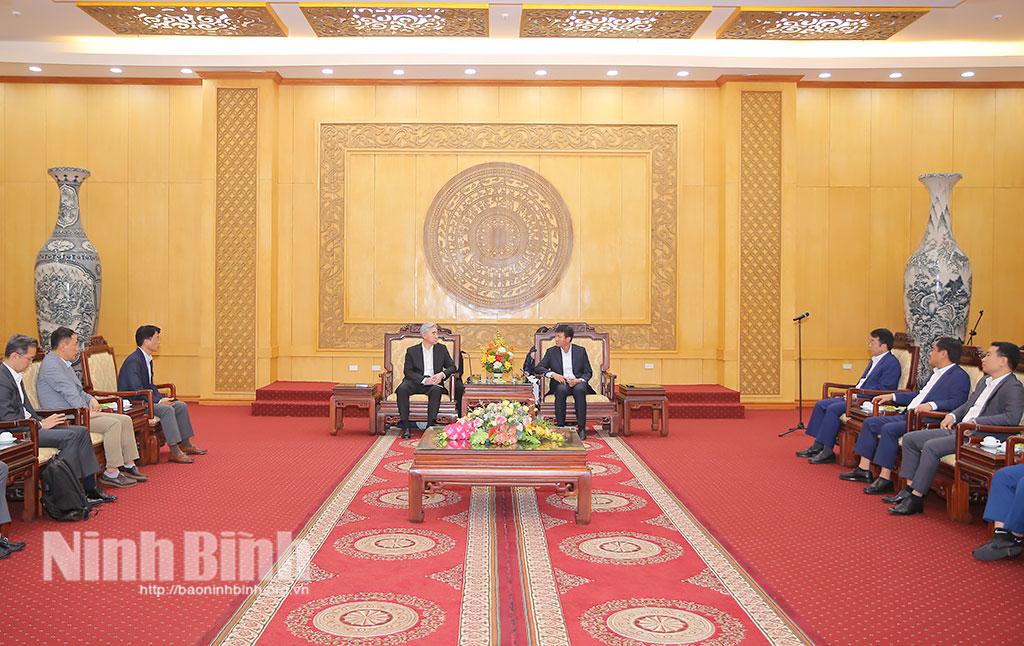
Secretary of Provincial Party Committee works with Hyundai Motor Company
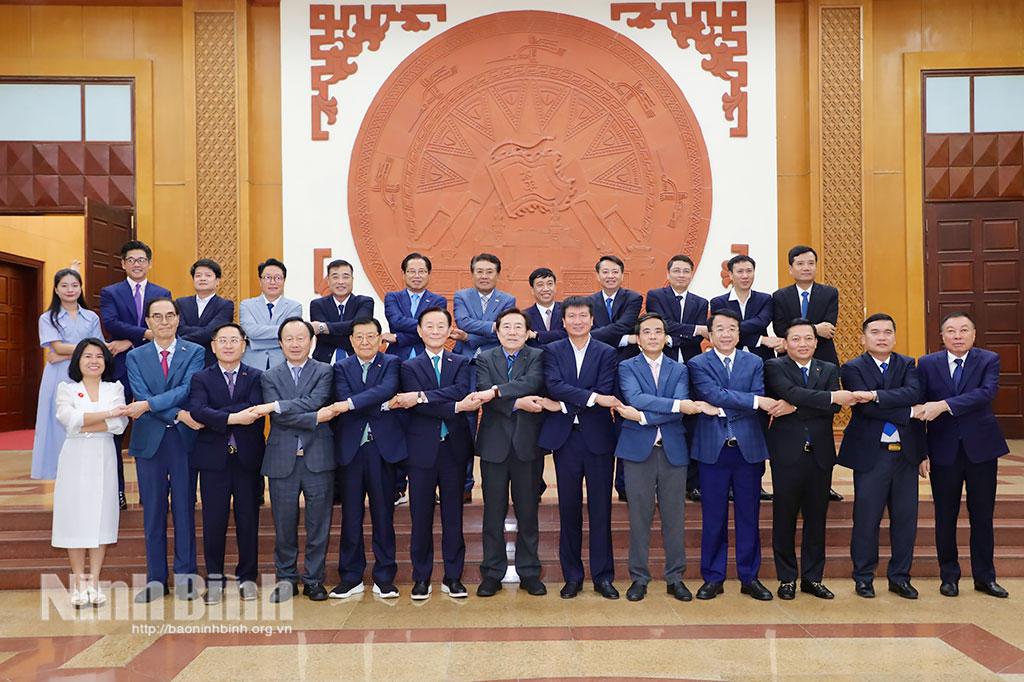
Secretary of Provincial Party Committee works with KBIZ delegation


Tin cùng chuyên mục