
Another population of Delacour’s langur discovered in Ninh Binh

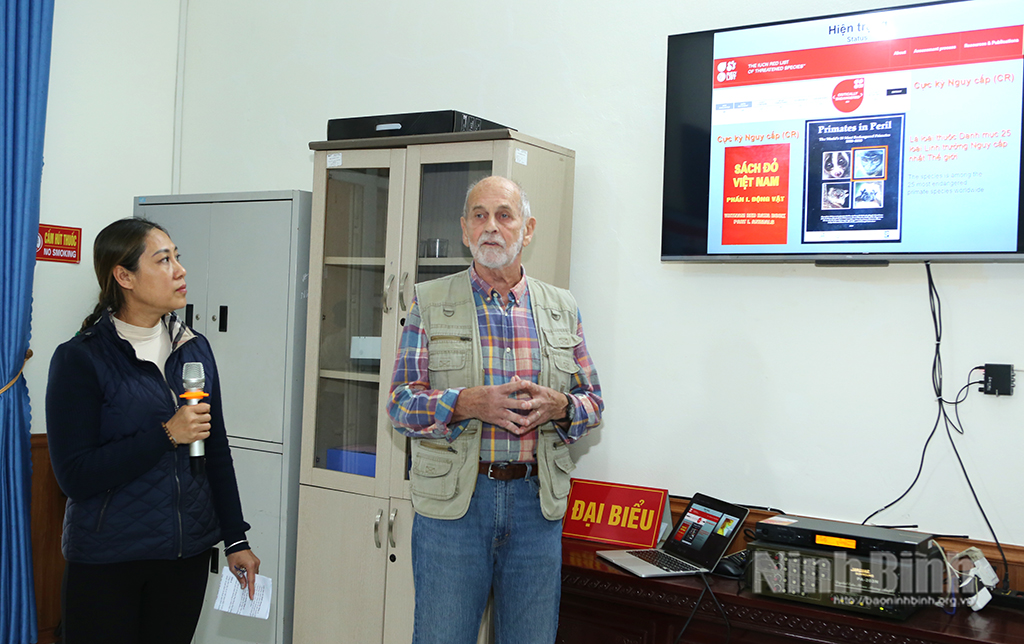
On December 30, the People's Committee of Dong Thai commune, in coordination with the Centre for Environmental Resources and Climate Change (CE REC), held a conference to announce the results of the wildlife survey in the protected forest in the commune.
At the conference, scientists stated that after a long period of surveying the wildlife in the Dong Thai protected forest (Dong Thai commune, covering an area of approximately 2,800 hectares), they discovered many rare and endangered wildlife species listed in the Vietnamese and World Red Books in this limestone mountain complex.
Notably, the white-buttocked Delacour’s langurs a primate species endemic to Vietnam, currently classified as "Criticalally Endangered" in the IUCN Red List and the Vietnamese Red Book was among them. A population of approximately 37 white-buttocked Delacour’s langurs was discovered through camera traps and drone surveys.
Tilo Nadler, a primate conservation expert from CE REC, shared that the Dong Thai protected forest is currently home to the third largest population of white-buttocked Delacour’s langurs in Vietnam. This is an endemic species, of exceptional value, and can be considered a "national treasure," therefore the area needs to be upgraded in terms of protection to ensure its long-term survival.
The Dong Thai limestone mountain complex, besides being home to the white-buttocked Delacour’s langur, is also home to many other endangered wildlife species. It boasts unique natural landscapes and has great potential for sustainable ecotourism development.
The early recognition of this area as a species and habitat conservation area is essential. This will be a prerequisite for the sustainable development of the locality in the future, Tilo said.
The survey results are not only significant for forest protection and development and nature conservation, but also serve as an important basis for Dong Thai commune and relevant authorities to accurately assess the ecological and landscape potential, opening up long-term directions for research and proposing models for ecotourism and experiential tourism development linked to conservation./.
Tin cùng chuyên mục

Top leader meets leading Danish businesses

NA deputies urge strengthening oversight of international agreements
Agricultural production enters year-end sprint
Awards ceremony convened for sixth Party ideology writing contest
Top Vietnamese leader hosts banquet in honour of Swiss President
