
Ninh Binh links science and technology with double-digit growth

Towards a digital economy accounting for at least 30% of GRDP
Under the Resolution of the first Ninh Binh Provincial Party Congress and the provincial Digital Transformation Project No. 01/DA-UBND dated April 23, 2026, the province aims to have the digital economy account for at least 30% of GRDP by 2030, while labour productivity is expected to increase by at least 9% annually and the share of the processing and manufacturing industry to exceed 43% of GRDP.
The province also aims to raise per capita GRDP to at least 180 millionVND, mobilise total social investment capital of around 1.39-1.45 quadrillionVND, and achieve export turnover of more than 40 billion USD.
Ninh Binh is implementing programmes to support small and medium-sized enterprises (SMEs) in applying digital technologies to management, production, marketing and payment, with a target of having at least 60% of SMEs adopt digital technologies by 2030. The province is also promoting cashless payments, with the goal of having 100% of transactions conducted electronically and 95% of people aged 15 and above having a bank account or e-wallet.
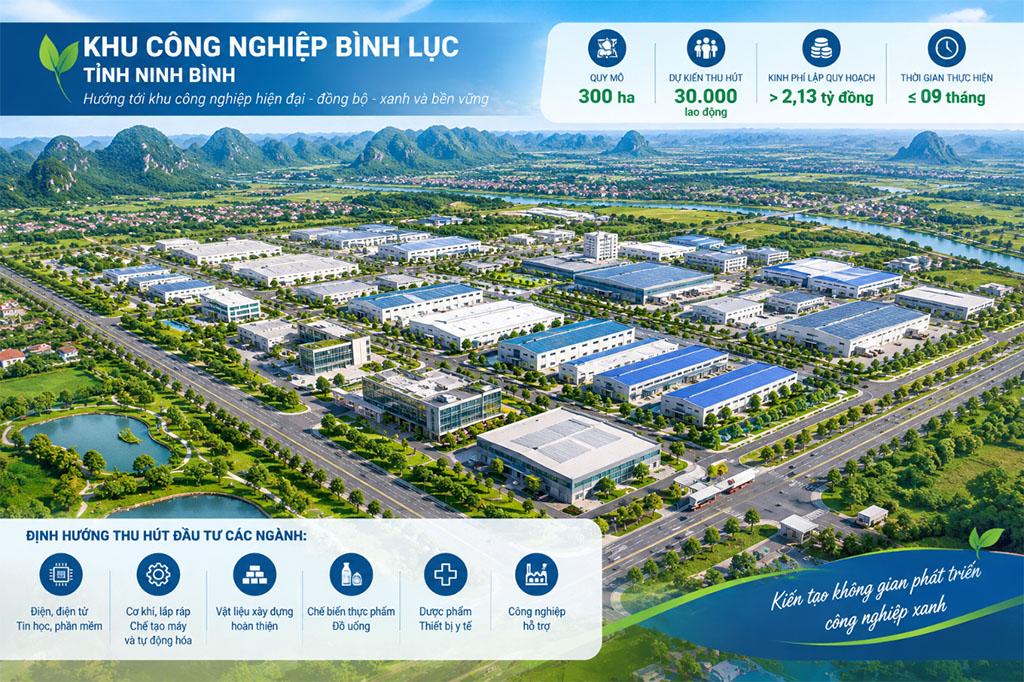
The province also plans to develop the Ninh Binh Hi-Tech Park, with a proposed scale of 663.19 hectares, creating favorable conditions for attracting investment in high-tech sectors. The development of the science and technology market, promotion of e-commerce and the introduction of local products on digital platforms are expected to help enhance competitiveness, expand markets and increase product value.
From policy orientations to practical implementation, the application of technology in production is opening up considerable room for Ninh Binh to improve productivity and the quality of economic growth.
In the first nine months of 2026, Ninh Binh's GRDP was estimated at 250.18 trillion VND, up 11.31% year on year. Of this, the agriculture, forestry and fisheries sector grew 3.06%; industry and construction expanded 15.58%; and services increased 9.95%. Industry continued to be one of the province's key growth drivers.
Notably, industrial value added rose 17.23%, contributing 6.68 percentage points to overall GRDP growth, while the Index of Industrial Production (IIP) increased 25.01%. The processing and manufacturing industry alone grew 25.38%. High growth was recorded in the electronics, computers and optical products, electrical equipment, and rubber and plastic products sectors.
These results reflect the continued expansion of production while also highlighting the need to improve productivity and value added through technological innovation, development of supporting industries and stronger linkages between foreign-invested enterprises and domestic businesses.
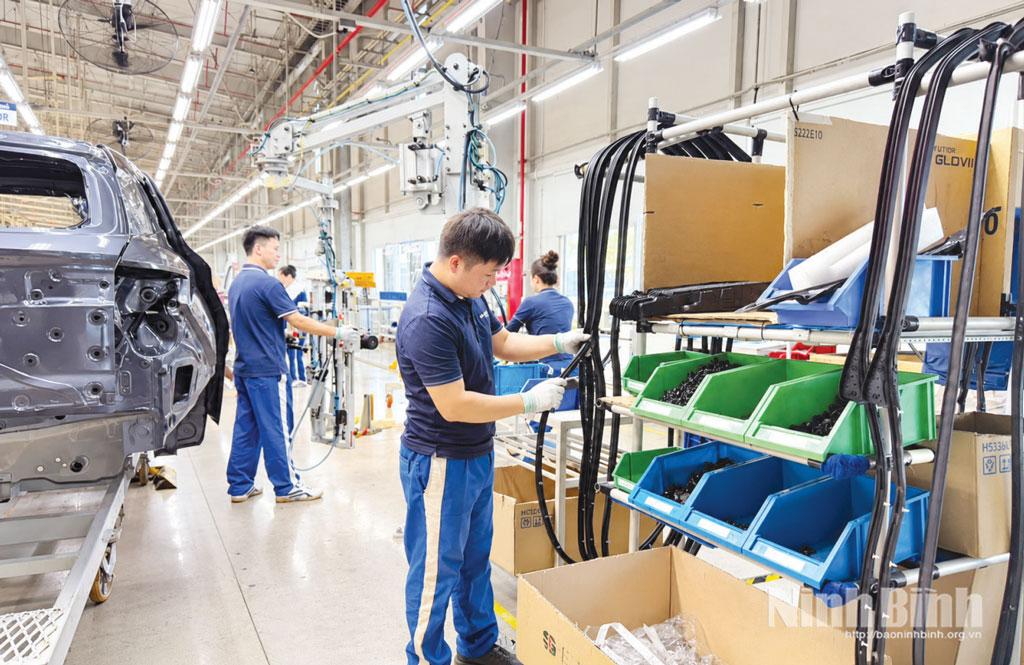
Practical models in Ninh Binh have demonstrated the potential fortechnology to improve productivity. In Ninh Van stone-carving craft village, CNC technology has been reported to increase productivity in some production stages by three to four times, while the level of automation at Nasaco's plant has reached around 90%. These examples highlight the potential of technology to reduce reliance on manual labor, shorten production times and improve product precision.
In the business sector, Ninh Binh currently has 21 science and technology enterprises, three innovative start-ups and one high-tech enterprise. These provide a foundation for further expanding technology applications in production and business activities.
In developing the science and technology market, the technology exchange platform has introduced 641 technologies and recorded 36 technology transfer contracts. Revenue from new or improved products and services accounted for around 24.1% at the surveyed enterprises.
E-commerce, digital services and technology platforms can support the promotion of and customer connections for agricultural products, OCOP products and goods produced by craft villages.
The models already implemented demonstrate considerable potential for applying technology to improve productivity and expand markets. However, targets for the digitaleconomy, labour productivity, investment attraction and exports remain goals to be achieved by 2030. To turn these orientations into concrete results, Ninh Binh needs to continue addressing bottlenecks related to resources, technology, human resources and businesses' capacity to adopt new technologies.
Unlocking resources and promoting technology adoption
According to the Ninh Binh Provincial People's Committee, for science and technology, innovation and digital transformation to make a substantive contribution to the goal of double-digit growth, the province needs to focus on removing bottlenecks in capital, infrastructure, human resources and businesses' capacity to adopt technology.
First, the province needs to accelerate disbursement of budget funds allocated to science and technology and digital transformation tasks, prioritising digital infrastructure and high-tech infrastructure projects with strong connectivity and practical potential for use. Capital allocation should be linked to specific objectives, implementation schedules and measurable outcomes.
Alongside public resources, the province needs to facilitate the mobilisation of private investment and attract foreign investment into high-tech sectors.
For businesses, the focus should be on supporting technological innovation, adoption and mastery of technologies suited to their scale, industries and production conditions.
At the same time, the science and technology market needs to be developed in a way that strengthens connections between technology providers and businesses seeking technological solutions.
In developing the digital economy, Ninh Binh needs to further improve its data infrastructure, ensure connectivity and data sharing in accordance with regulations, and enhance data quality for management and administration.
For e-commerce, support for OCOP products, agricultural products and craft-village goods should be linked to traceability, quality standardisation, order-fulfillment capacity and brand building.
Human resources are also a decisivefactor in the effectiveness of technology investment. The province needs to step up training of high-quality human resources, improve workers' digital skills and strengthen enterprises' technology management capacity, while promoting closer links among educational institutions, research institutes and businesses.
With the goal of achieving average GRDP growth of at least 11% annually during 2026-2030, it is essential to measure the effectiveness of science and technology and digital transformation programs. Labor productivity, cost savings, revenue from new products, the effectiveness of technology transfers and the ability to expand markets should become key indicators for assessing outcomes.
Only when resources are allocated to the right priorities and businesses strengthen their capacity to adopt technology can innovation and digital transformation make a more visible contribution to improving the quality of economic growth and achieving Ninh Binh's economic development goals./.

Tin cùng chuyên mục